How to Track Whether Your Brand Shows Up in AI Search (Step-by-Step)
Don't know if ChatGPT or Perplexity is mentioning your brand? Learn how to check your AI visibility step by step manually or automatically — in under 30 minutes.
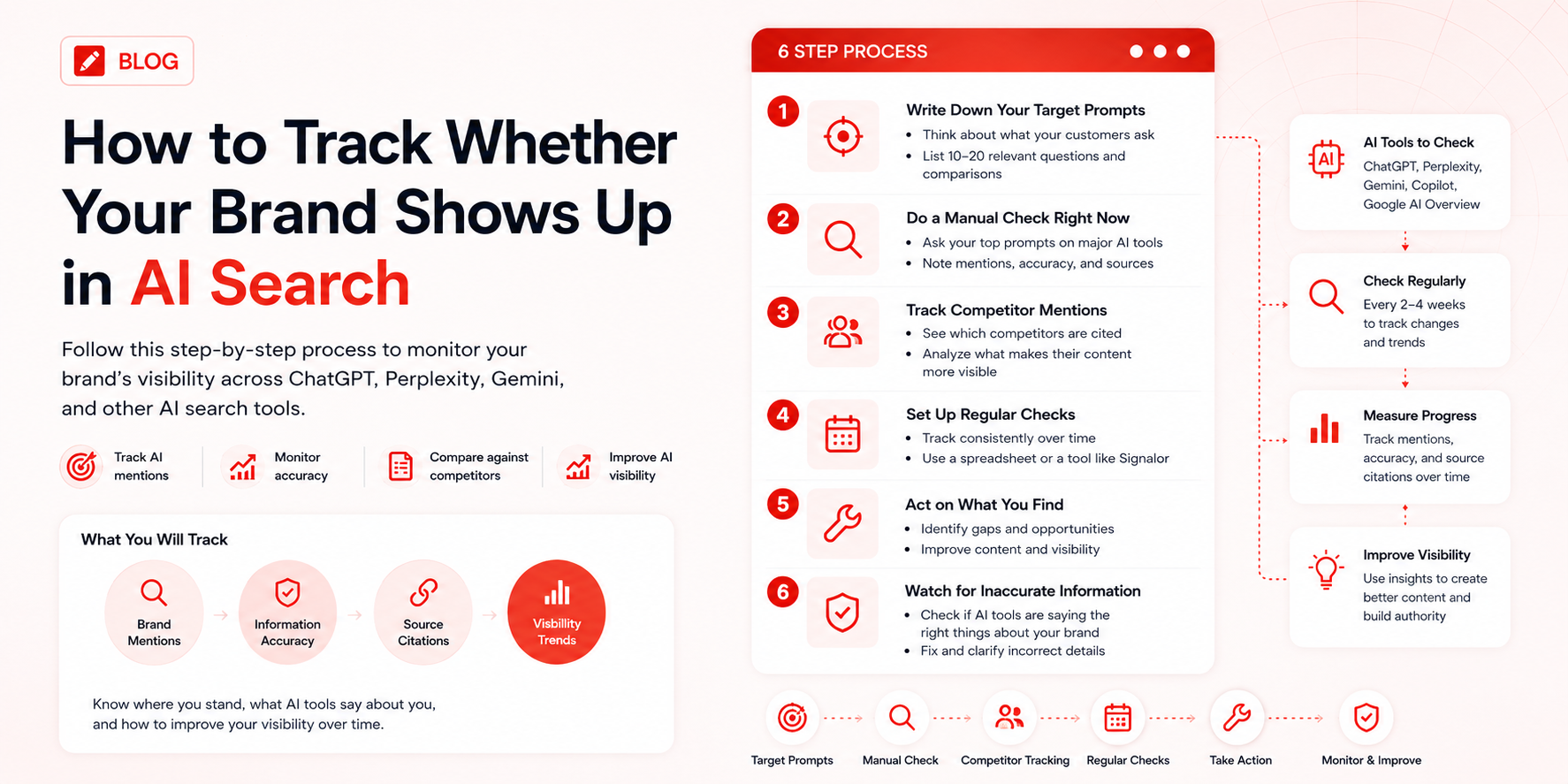
Most businesses have no idea what AI tools are saying about them.
They check their Google rankings. They track their website traffic. But when it comes to ChatGPT, Perplexity, and Gemini they're flying blind.
This is a problem. Because right now, your potential customers are asking AI tools about products and services like yours. If you don't know whether your brand is being mentioned in those answers, you can't improve it.
This guide shows you how to start tracking your AI search visibility from simple manual checks you can do today, to proper ongoing monitoring.
Step 1: Write Down Your Target Prompts
Before you can track anything, you need to know what you're tracking.
A target prompt is a question that a potential customer might ask an AI tool before finding your business. These are the queries where you want to show up.
Think about:
- What questions do your customers ask before they buy from you?
- What comparisons do they make? (X vs Y)
- What problems are they trying to solve?
- What does your category look like in a question? (best [category] for [type of person])
Write down 10–20 prompts that feel most relevant. Some examples:
- What's the best project management tool for small teams?
- What tools help track AI search visibility?
- How do I improve my brand's presence in ChatGPT?
- Which AI visibility platforms are worth using?
These become your tracking list.
Step 2: Do a Manual Check Right Now
Open ChatGPT, Perplexity, and Google AI Overview (just search on Google). Ask each one your top 5 target prompts. Note down:
- Does your brand get mentioned?
- If yes, what does it say about you? Is it accurate?
- If no, which brands are getting mentioned instead?
- Does your website get linked as a source?
This gives you a baseline. You now know where you stand today.
It's worth doing this check in a private/incognito browser window so that your previous searches don't influence the results.
What You Might Find
Your brand gets mentioned accurately
Great! Your job is to maintain and improve this. Note the prompt and come back in a month to check it's still happening.
Your brand gets mentioned inaccurately
This is a common and important problem. If an AI tool is describing your product, pricing, or audience incorrectly, it's giving potential customers wrong information. You need to fix this by making sure your website has clear, correct information that's easy for AI to read.
Your brand doesn't get mentioned at all
The most common finding. Note which competitors do appear. This tells you who the AI currently trusts more than you for these queries and gives you a benchmark to work toward.
Your brand gets mentioned for some queries but not others
This is actually useful. It tells you which topics you're already associated with in AI search, and where the gaps are.
Step 3: Track Competitor Mentions
While you're doing your manual checks, note down which competitors are being cited.
If you ask ChatGPT "best email marketing tool for small businesses" and it mentions three specific competitors, that's valuable intelligence. It tells you who the AI currently considers authoritative in your space.
Look at those competitors' websites. Notice:
- How is their content structured?
- Do they have clear FAQ sections?
- Do their pages answer questions directly?
- Are they mentioned in external publications?
You're not copying them you're understanding what's working so you can apply the same principles to your own content.
Step 4: Set Up Regular Checks
The problem with manual checks is they're slow and inconsistent. You'd need to ask dozens of prompts across multiple AI tools every week and log everything in a spreadsheet to get a clear picture of how your visibility is changing over time.
Most businesses can't sustain that. It takes too much time and the data isn't systematic enough to act on confidently.
There are two practical approaches:
Option A: A simple manual tracking spreadsheet Create a spreadsheet with your target prompts in the rows and the AI tools in the columns (ChatGPT, Perplexity, Gemini, Copilot). Every two weeks, check each prompt on each tool and mark whether you were cited (Yes/No) and any notes. This is low-cost but time-consuming.
Option B: Use a tool like Signalor Signalor automates all of this. You enter your target prompts, and Signalor checks them across all major AI tools automatically tracking whether you're cited, what's said about you, how you compare to competitors, and how your visibility changes over time.
For businesses that are serious about AI search visibility, automated tracking is the only way to get reliable data without spending hours every week on manual checks.
Step 5: Act on What You Find
Tracking is only valuable if it leads to action.
When you notice a prompt where you're consistently not being cited, ask:
- Does my website have a page that clearly answers this question?
- Is that page up to date?
- Am I mentioned externally in relation to this topic?
When you notice a prompt where you used to be cited but stopped appearing:
- Was there a content update that removed useful information?
- Did a competitor publish better content on this topic?
- Is the page that used to be cited now out of date?
The goal is a regular review cycle: track → analyse → fix → recheck.
Step 6: Watch for Inaccurate Information
This step is easy to miss, but it's important.
AI tools sometimes cite brands with incorrect information wrong pricing, outdated product descriptions, incorrect target audiences. This can actively hurt your brand if potential customers are acting on that misinformation.
As part of your regular checks, read what AI tools are saying about you, not just whether they're mentioning you. If you find inaccuracies:
- Update your website to make the correct information clearer and more prominent
- Make sure your key facts are easy to find and extract from your pages
- Use structured data (schema) to label your key facts explicitly
Quick Recap
- Most businesses have no idea what AI tools are saying about them this is a significant blind spot
- Start by writing 10–20 "target prompts" your customers might ask AI tools
- Do a manual check right now on ChatGPT, Perplexity, and Google to see where you stand
- Note competitor mentions they tell you who the AI currently trusts in your space
- Set up regular tracking, either manually with a spreadsheet or automatically with a tool like Signalor
- Watch for inaccurate information about your brand, not just absence of mentions
Get started
Turn AI search into your highest-intent pipeline
Run a free GEO audit, track citations across models, and ship fixes that change how ChatGPT, Perplexity, and Gemini talk about you.
No credit card required · 50 free prompts · Cancel anytime
