AI Won't Replace Your Marketing Strategy. Bad Strategy Will.
Every agency claims to be AI-powered. But AI doesn't fix bad strategy it amplifies it. Here's why brand clarity and positioning must come before AI tools, and how to check your AI visibility.
Open LinkedIn right now and count how many agencies describe themselves as AI-powered. Then count how many of those same agencies can tell you, in one sentence, who their client's ideal customer actually is.
The gap between those two numbers is the entire problem with how the marketing industry talks about AI.
AI has become a badge. A line on a homepage. A way of signalling modernity without necessarily changing anything underneath. And here's the uncomfortable truth most of the AI-powered conversation avoids: AI doesn't make a weak strategy stronger. It makes it faster.
A fast bad strategy is one of the most expensive things in marketing because now you can produce ten times the content, run ten times the campaigns, and generate ten times the noise, all pointed in a direction that was never going to work.
Strategy first. AI second. That order isn't a sloganit's the difference between AI as a multiplier and AI as an amplifier of your mistakes.
Phase 1: The AI hype problem in marketing
There's no shortage of genuinely useful AI applications in marketing today. Content production at scale, personalisation across thousands of audience segments, rapid creative testing, and increasingly visibility within AI search and chat platforms. These are real capabilities, and brands that ignore them are leaving efficiency on the table.
But here's what AI cannot do, no matter how advanced the model: it cannot tell you who your brand is for. It cannot decide what your positioning should be relative to competitors. It cannot determine which customer segment is worth pursuing and which one is a distraction. It cannot build the strategic intent that everything else gets built on top of.
This distinction matters because most of the "AI-powered" messaging in the market quietly blurs it. The implication is that AI tools are a substitute for strategic thinking that if you adopt the right software, the thinking part becomes optional. It doesn't. It becomes more important, because now the cost of being wrong is amplified at speed.
Phase 2: What AI actually amplifies
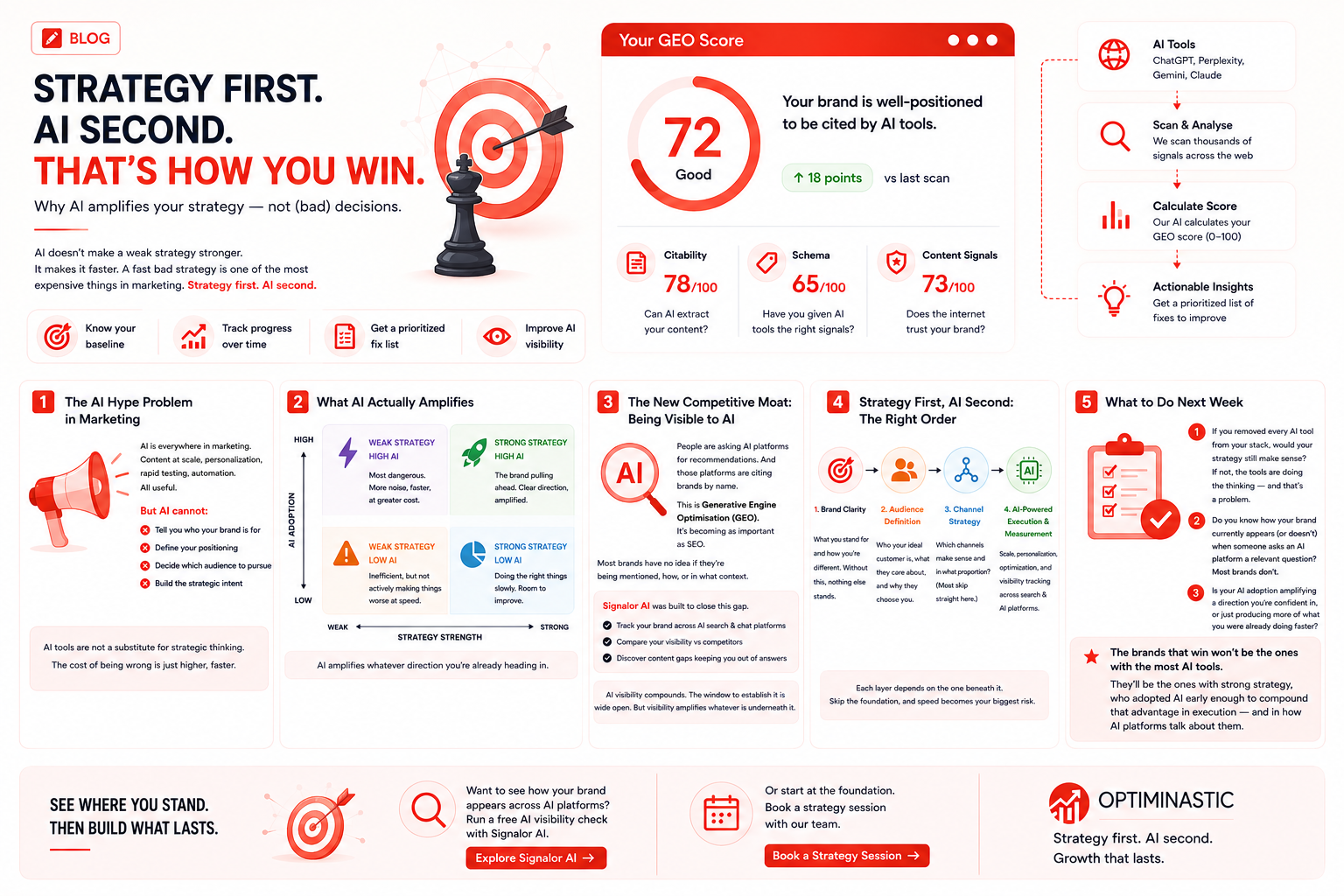
Here's the mental model worth holding onto: AI doesn't change your direction. It amplifies whatever direction you're already heading in.
Picture a simple two-by-two. On one axis, the strength of your underlying strategy how clear you are on positioning, audience, and differentiation. On the other axis, your level of AI adoption in execution.
A brand with strong strategy and low AI adoption is doing the right things slowly. There's room for improvement, but the foundation is sound.
A brand with strong strategy and high AI adoption is the brand pulling ahead right now clear on direction, and using AI to execute that direction faster, cheaper, and at greater scale than competitors relying on manual processes.
A brand with weak strategy and low AI adoption is treading water inefficient, but at least not actively making things worse at speed.
And a brand with weak strategy and high AI adoption is the most dangerous quadrant of all. This is the brand producing huge volumes of content, running automated campaigns across every channel, personalising messages at scale all built on a positioning that doesn't differentiate, targeting an audience that was never properly defined. AI doesn't fix that. It multiplies it. More noise, faster, at greater cost.
The brands asking "should we adopt more AI tools?" are often asking the wrong question. The right question is: "is our strategic foundation strong enough that more execution speed would actually help us?"
Phase 3: The new competitive moat being visible to AI
There's a shift happening right now that most brands haven't fully registered yet, and it's reshaping how discovery works.
Increasingly, people aren't just searching Google. They're asking ChatGPT, Gemini, Claude, and Perplexity directly "what's the best project management tool for a small team," "which skincare brand is good for sensitive skin," "who should I hire for performance marketing in Dubai." These AI platforms generate answers by drawing on content across the web, and they cite specific brands by name.
This is Generative Engine Optimisation, or GEO and it's quickly becoming as important as traditional SEO, with one critical difference: most brands have no idea whether they're being mentioned, how favourably, or in what context.
This is exactly the gap Signalor AI was built to close. It's our proprietary platform for tracking and improving how brands appear across AI search and chat platforms surfacing where you're being cited, how you compare to competitors in AI-generated answers, and what content gaps are keeping you out of those responses altogether.
The brands that get ahead of this now are building a genuinely durable advantage, because AI visibility compounds the same way SEO authority used to except the window to establish it is still wide open.
But here's the connection back to Phase 2: GEO only works if there's something coherent for AI platforms to find and recommend. A brand with unclear positioning doesn't become clearer because it shows up in more AI-generated lists. Visibility amplifies whatever is underneath it which brings us back to where every AI conversation in marketing should start.
Phase 4: Strategy first, AI second the right order of operations
At Optiminastic, every engagement follows the same sequence, regardless of how sophisticated the AI tooling involved ends up being.
Brand clarity comes first. What does this brand stand for, and how is that different from the five competitors a customer might consider instead? Without a clear answer here, nothing built afterward has solid ground to stand on.
Audience definition comes second. Not broad demographics, but a genuine understanding of who the ideal customer is, what they care about, where they spend time, and what would make them choose this brand over an alternative.
Channel strategy comes third. Given who the audience is and what the brand stands for, which channels make sense and in what proportion? This is where most "AI-powered" pitches actually start, which is part of the problem.
AI-powered execution and measurement comes fourth. This is where AI tools genuinely shine producing content variations at scale, personalising messaging across segments, optimising bids and budgets in real time, and tracking visibility across both traditional and AI-driven search.
Each layer depends entirely on the one beneath it. Skip to layer four without the first three in place, and you get exactly what we described in Phase 2 — fast execution in a direction that was never going to convert.
This is also why the most effective AI adoption doesn't look like a wholesale transformation. It looks like a strategic foundation that was already strong, now moving faster.
Phase 5: What to do next week
Before adopting another AI tool, or signing with another "AI-powered" agency, sit down with your team and answer three questions honestly.
One. If you removed every AI tool from your current marketing stack, would your strategy still make sense? If the answer is no, the tools have been doing the strategic thinking and that's a risk, not an efficiency gain.
Two. Do you know how your brand currently appears or doesn't appear when someone asks an AI platform a question relevant to your category? Most brands genuinely don't know the answer to this yet.
Three. Is your current AI adoption amplifying a direction you're confident in, or is it just producing more of what you were already doing faster?
The brands that will be hardest to compete with over the next few years won't be the ones with the most AI tools. They'll be the ones with strong strategic foundations who adopted AI early enough to compound that advantage in execution, and increasingly, in how AI platforms themselves talk about them.
Strategy isn't being replaced. It's being amplified. The only question is which direction.
Want to see how your brand currently appears across AI search and chat platforms?
Run a free AI visibility check with Signalor see where your brand is being mentioned, how you compare to competitors, and where the gaps are.
Or if you'd rather start at the foundation positioning, audience, and channel strategy book a strategy session with our team.
Get started
Turn AI search into your highest-intent pipeline
Run a free GEO audit, track citations across models, and ship fixes that change how ChatGPT, Perplexity, and Gemini talk about you.
No credit card required · 50 free prompts · Cancel anytime
