Why Your Brand Isn't Showing Up in ChatGPT (And What You Can Do About It)
Ranking on Google but invisible in ChatGPT? Discover the 7 simple reasons your brand isn't being cited by AI tools — and exactly what to fix first.
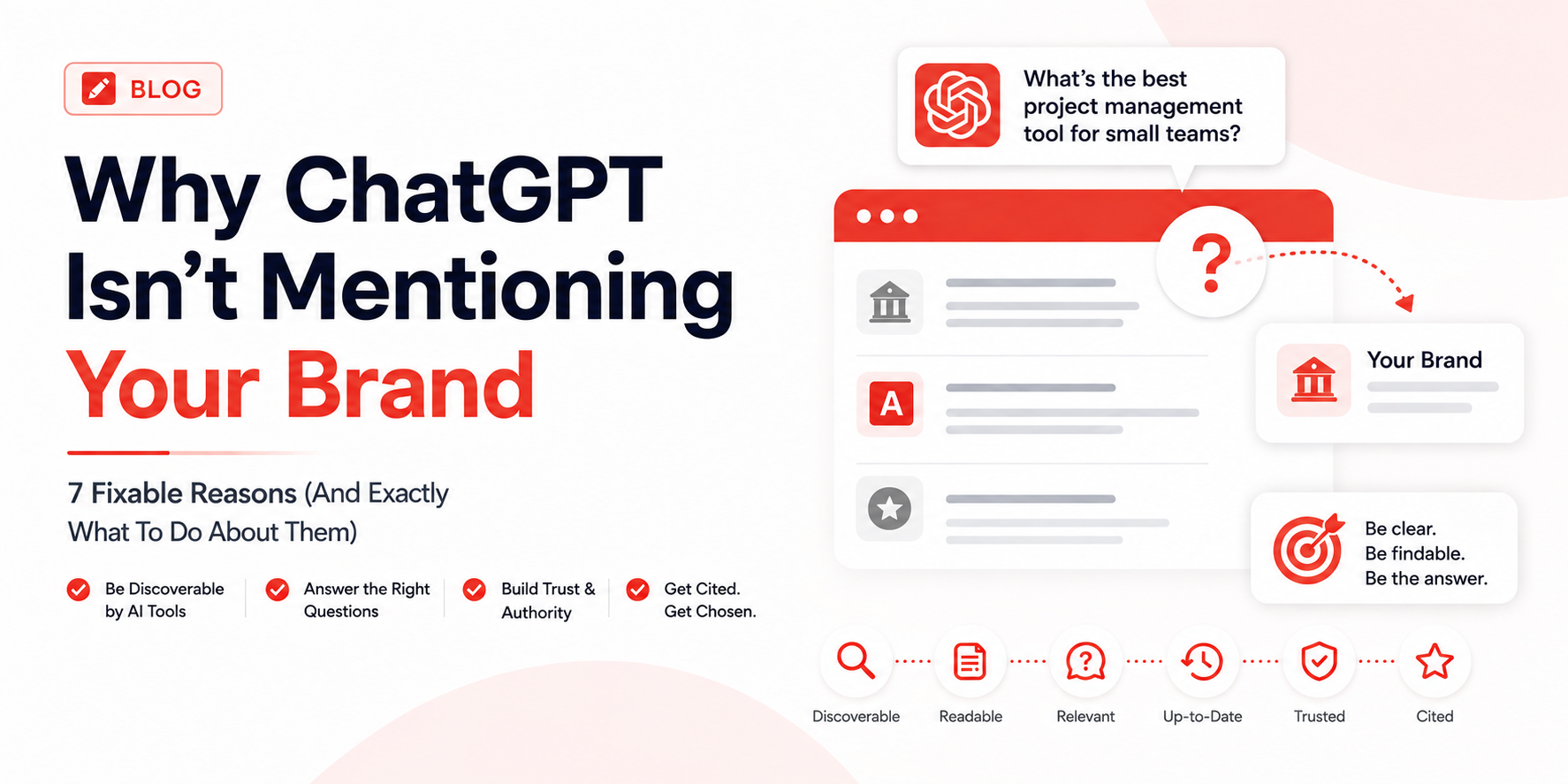
You've done the work. You have a website. You've written blog posts. Maybe you even rank well on Google.
But when you ask ChatGPT about your industry or type in the kind of question your customer would ask your brand is nowhere to be found.
Competitors you've never heard of get mentioned. Big generic names come up. But not you.
This is one of the most common frustrations we hear from business owners right now. And the good news is: it's not random. There are specific, fixable reasons why ChatGPT isn't mentioning your brand and this post walks through all of them.
Reason 1: ChatGPT Doesn't Know You Exist Yet
ChatGPT doesn't automatically know about every business on the internet. It has two ways of finding information:
Training data everything it learned during its training process, which has a cutoff date. If your brand wasn't written about much before that cutoff, the AI simply doesn't have much information about you stored in its memory.
Live web search when ChatGPT browses the internet in real time to answer a question. This is more up-to-date, but it still depends on your pages actually being findable and readable.
If your website is new, small, or hasn't been written about by other publications, ChatGPT may have almost no information about you. You can't be mentioned if you're not known.
What to do: Start building your presence outside your own website. Get mentioned in industry blogs, directories, review sites like G2 or Trustpilot, and any publications your customers read. The more places you exist on the internet, the more the AI has to work with.
Reason 2: Your Website Isn't Easy for AI to Read
Here's something most people don't realise: AI tools don't "read" websites the way a human does. They scan pages quickly, looking for clear, structured information they can extract and use in an answer.
If your website content looks like this:
"At Acme Solutions, we pride ourselves on delivering world-class, innovative, end-to-end solutions that empower businesses to unlock their full potential across multiple touchpoints..."
An AI tool will struggle to extract anything useful from that. It's vague marketing language with no clear information.
But if your content looks like this:
"Acme Solutions is a project management tool for small businesses. It helps teams track tasks, set deadlines, and manage workloads in one place. Plans start from £15/month."
That's clear, specific, and easy for an AI to pull directly into an answer.
What to do: Rewrite your most important pages to be direct and clear. Lead with the most important information. Use simple headings. Answer the obvious questions a customer would have what do you do, who is it for, how much does it cost, why should I trust you.
Reason 3: You're Not Answering the Questions People Are Actually Asking
ChatGPT gets cited when it finds a page that directly answers the question being asked.
If someone asks "what's the best accounting software for freelancers" and your website is an accounting software company but none of your pages actually answer that exact question ChatGPT will go find a page that does. Probably a comparison site or a competitor's blog.
What to do: Think about the questions your customers type into AI tools. Not just "accounting software" but "best accounting software for freelancers under £20 a month" or "do I need accounting software if I'm self-employed." Write blog posts or FAQ pages that answer these questions directly. Put the answer in the first paragraph, not at the end after three paragraphs of introduction.
Reason 4: Your Content Is Out of Date
AI tools especially Perplexity strongly prefer recent content. A blog post you wrote in 2021 that hasn't been touched since is much less likely to be cited than a page that was updated last month.
This catches a lot of businesses off guard. They wrote great content a few years ago, assumed it was "done," and moved on. But AI tools see that old date and deprioritise it.
What to do: Go back to your most important pages and update them. Add new statistics or examples. Update any numbers that have changed. Change the "last updated" date. You don't have to rewrite everything even refreshing the data points and examples can be enough to signal to AI tools that this content is current.
Reason 5: Your Website Isn't Indexed in the Right Places
ChatGPT uses Microsoft Bing as its main source when searching the web. Most businesses focus entirely on Google and never check Bing at all.
If your pages aren't indexed in Bing, ChatGPT literally cannot find them no matter how good your content is.
What to do: Go to Bing Webmaster Tools (it's free at webmaster.bing.com), add your website, and submit your sitemap. Check that your important pages are indexed. This single step takes about 30 minutes and fixes one of the most common invisible blockers for ChatGPT visibility.
Reason 6: AI Tools Don't Know Enough About Who You Are
AI tools are much more likely to mention brands they have a clear, confident understanding of. If the AI is unsure what your company does, who it serves, or whether it's legitimate it won't risk mentioning you.
This is called "entity clarity." The AI needs to know: who are you, what do you do, who do you help, and are you trustworthy?
Signs the AI might be confused about your brand:
- Your website doesn't have a clear "About" page
- You're not listed on Wikipedia, LinkedIn, or industry directories
- Different pages on your site describe your product differently
- There's very little written about you by anyone other than yourself
What to do: Make sure your About page is clear and descriptive. Claim and fill out your LinkedIn company page. Get listed in relevant industry directories. If you're eligible for a Wikipedia page (typically requires press coverage), it's worth pursuing Wikipedia is one of ChatGPT's most-cited sources.
Reason 7: Your Competitors Simply Started Earlier
This one is uncomfortable but true. The brands getting cited by ChatGPT and Perplexity right now are mostly the ones that started thinking about AI visibility 6–12 months ago.
They optimised their content. They got more external mentions. They made their sites easy for AI crawlers to read. And now they're getting cited consistently, which builds momentum over time.
The good news: it's not too late. AI citation patterns shift as new content is indexed and old content becomes stale. Brands that take action now can close the gap relatively quickly.
Where to Start
If you're new to all of this, don't try to fix everything at once. Here's a simple starting order:
Check Bing indexing Make sure ChatGPT can even find your pages (Bing Webmaster Tools, free)
Rewrite your homepage and key pages Make them clear, specific, and answer-focused
Add an FAQ section to your most important pages
Update your oldest important content Refresh the data and examples
Get mentioned elsewhere Aim for at least a few external publications or directories mentioning your brand
None of these steps require a developer or a big budget. They require clarity about what your business does and the willingness to communicate it plainly.
Quick Recap
- ChatGPT won't mention you if it doesn't have clear, reliable information about your brand
- Vague marketing language is hard for AI to extract and use be specific and direct
- Your content needs to answer the actual questions people are asking
- Old, stale content gets deprioritised keep important pages updated
- ChatGPT uses Bing, not Google check your Bing indexing
- The more places you're mentioned online, the more AI tools trust and cite you
Get started
Turn AI search into your highest-intent pipeline
Run a free GEO audit, track citations across models, and ship fixes that change how ChatGPT, Perplexity, and Gemini talk about you.
No credit card required · 50 free prompts · Cancel anytime
